
Quito vs Other Andean Capitals: What Makes It Unique?
High in the Andes, several capital cities share dramatic mountain backdrops, colonial history, and vibrant Indigenous influence. Yet among them, Quito stands apart. While cities like La Paz, Bogotá, and Lima each offer distinct cultural experiences, Ecuador’s capital holds a character that feels both intimate and monumental at the same time.
So what truly makes Quito unique among the Andean capitals?
A Historic Center Like No Other
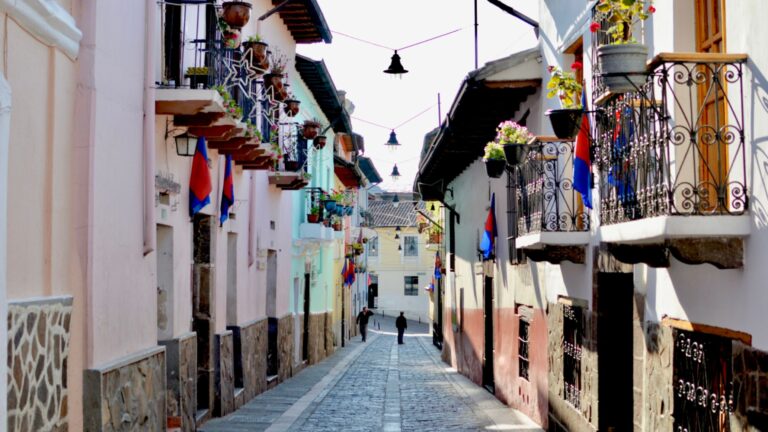
One of Quito’s greatest distinctions is its exceptionally well-preserved historic center. Recognized as a UNESCO World Heritage Site in 1978, Quito’s Old Town is considered one of the largest and best-preserved colonial centers in Latin America.
Unlike many capitals where modern development has overshadowed historic districts, Quito’s colonial churches, monasteries, and plazas remain central to daily life. Walking through its narrow streets feels immersive rather than curated. The architectural richness rivals that of Lima, yet Quito’s historic core feels more compact, walkable, and cohesive.
Dramatic Geography at 2,850 Meters
At 2,850 meters above sea level, Quito is one of the highest official capitals in the world. Unlike Lima, which lies along the Pacific coast, or Bogotá, which stretches across a broad plateau, Quito unfolds in a narrow valley framed by volcanoes.
From nearly anywhere in the city, snowcapped Cotopaxi or the green slopes of Pichincha can dominate the horizon. The proximity to active volcanoes and cloud forests creates a dramatic setting that feels raw and immediate. Nature is not distant from the city, it surrounds it.
A Balance Between Scale and Accessibility
Compared to Bogotá, which is vast and fast-paced, or La Paz, which can feel chaotic and vertically intense, Quito offers a more manageable urban experience. It is large enough to provide cultural institutions, gastronomy, and nightlife, yet compact enough to explore comfortably.
Visitors can transition from colonial plazas to modern neighborhoods, and from there to mountain trails, all within a short distance. This balance gives Quito a sense of accessibility that many larger capitals lack.
Cultural Layers in Everyday Life
Like La Paz, Quito reflects strong Indigenous heritage interwoven with Spanish colonial influence. However, what distinguishes Quito is the subtle coexistence of tradition and modernity. Indigenous markets, Catholic processions, contemporary art galleries, and innovative cuisine exist side by side.
While Lima is often praised for its gastronomy and Bogotá for its creative scene, Quito blends heritage and emerging culture in a way that feels less commercial and more integrated into daily life.
The Middle of the World
Few capitals can claim such a symbolic geographic identity. Just outside the city lies the Equator line, where visitors can literally stand in both hemispheres. This geographical uniqueness reinforces Quito’s sense of place and identity. It is not only a political capital, but a geographic landmark.
Why Quito Feels Different
What ultimately makes Quito unique is not just its altitude, architecture, or scenery. It is the atmosphere. The city feels layered yet intimate, historic yet alive. It invites exploration without overwhelming the visitor.
Among the Andean capitals, Quito stands as a bridge between past and present, nature and city, tradition and innovation. It may not be the largest or the busiest, but it offers something arguably more valuable: depth, authenticity, and a sense of place that lingers long after departure.
Why Visit Quito?
Quito offers a rare combination of history, geography, and cultural depth within a remarkably accessible setting. Few capitals allow you to explore a UNESCO-listed historic center in the morning, stand on the Equator by midday, and hike on a volcanic slope in the afternoon.
Beyond its landmarks, Quito invites travelers to slow down and observe. Its layered identity, shaped by Indigenous roots and colonial legacy, creates an atmosphere that feels both reflective and dynamic. For those seeking authenticity, scenic beauty, and meaningful cultural experiences, Quito stands out as one of the most rewarding capitals in the Andes.
